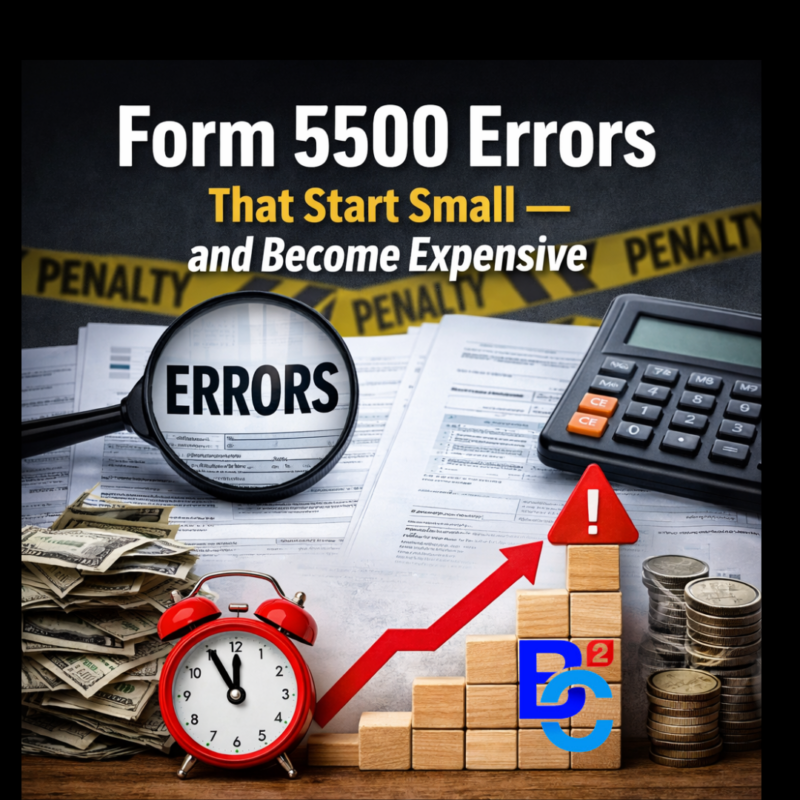
Form 5500 is not just a routine filing. It is a public disclosure document reviewed by the Department of Labor and the IRS.
Small errors are rarely isolated. They often signal weak internal controls, inconsistent plan administration, or incomplete documentation.
What looks minor, a participant miscount, a wrong plan number, a missing schedule, can trigger follow-up notices, amended filings, or audit inquiries.
Most problems do not start large. They start unnoticed.
Incorrect Participant Counts
Participant counts are one of the most common Form 5500 errors.
Employers frequently:
-
Miscount eligible employees versus active participants
-
Exclude terminated employees with account balances
-
Misclassify part-time or newly eligible employees
-
Carry forward prior-year numbers without verification
Incorrect counts can affect audit requirements and reporting accuracy. If a plan crosses the audit threshold due to miscalculation, the correction process becomes more complex and expensive.
Accurate counts are essential to proper filing. Employers who need structured support often rely on accurate Form 5500 preparations to verify plan data before submission.
Accurate participant data should be verified before filing, not assumed.
Plan Numbers, EINs, and Administrative Data Errors
Administrative errors often appear minor but create filing complications.
Common issues include:
-
Using an incorrect or inconsistent plan number
-
Filing under the wrong EIN
-
Failing to update the plan name or sponsor information
-
Reporting outdated contact or administrator details
These inconsistencies can trigger rejection notices or require amended filings. Repeated administrative errors year over year increase scrutiny.
Form 5500 data should match the current plan structure and official documentation exactly.
Schedule Omissions and Incomplete Attachments
A Form 5500 filing is not complete without the required schedules and attachments.
Common problems include:
-
Missing Schedule A for insured benefits
-
Incomplete Schedule H or I financial reporting
-
Failure to include the required accountant’s reports when applicable
-
Uploading partial or incorrect supporting documentation
An incomplete filing can be treated as a non-filing. That increases exposure to penalties and corrective filings.
Each required schedule should be confirmed before submission. Assumptions lead to rework.
Incomplete filings can expose employers to unnecessary risk. Understanding the consequences outlined in penalties for incomplete Form 5500 filings underscores the importance of full verification.
Non-Discrimination Issues That Surface During Filing
Contribution and eligibility structures must be reviewed regularly.
During Form 5500 preparation, employers often discover:
-
Contribution formulas applied inconsistently
-
Eligibility rules not aligned with plan documents
-
Plan changes are not formally documented
-
Employee groups are treated differently without proper review
These issues are typically identified late, during filing or audit activity. A structured non-discrimination plan review helps identify plan design issues before they lead to greater compliance exposure.
Non-discrimination testing helps identify plan design issues before filings are finalized and before they create larger compliance exposure.
Repeated Errors Year Over Year
Many employers rely on prior-year filings as templates.
That approach carries forward mistakes.
Common repeat errors include:
-
Copying forward outdated participant counts
-
Reusing incorrect plan numbers
-
Failing to update amendments
-
Assuming prior approvals mean ongoing accuracy
“Accepted last year” does not mean correct this year.
Repeated inaccuracies increase the likelihood of regulatory scrutiny and corrective filings.
Small errors become costly when repeated.
What Proactive Employers Do Differently
Employers who avoid Form 5500 problems follow a simple process.
They:
-
Verify participant data before the filing season
-
Review plan documents against current operations
-
Confirm required schedules in advance
-
Identify potential non-discrimination concerns early
-
Schedule preparation instead of reacting to deadlines
They treat Form 5500 as a compliance checkpoint — not a last-minute task.
Accuracy is planned, not rushed.
How BC2 Reduces Form 5500 Risk
BC2 helps employers reduce filing exposure by focusing on accuracy and verification.
Our support includes:
-
Pre-filing Form 5500 review
-
Participant count validation
-
Administrative data cross-check
-
Schedule verification
-
Documentation alignment with plan operations
The objective is simple: identify issues before submission, not after.
Early correction reduces the likelihood of amended filings, enforcement inquiries, and unnecessary penalties.
Fix Small Errors Before They Become Expensive
Most Form 5500 penalties do not begin with major violations. They begin with overlooked details.
A miscount.
An outdated plan number.
A missing schedule.
A copied prior-year mistake.
Employers reviewing their broader compliance framework can also revisit ERISA compliance and plan documentation guidance to ensure alignment before the filing season closes.
When identified early, these issues are manageable. When ignored, they escalate.
Reviewing and correcting errors before filing closes reduces risk and maintains compliance.
Small errors are easier to fix now than later.